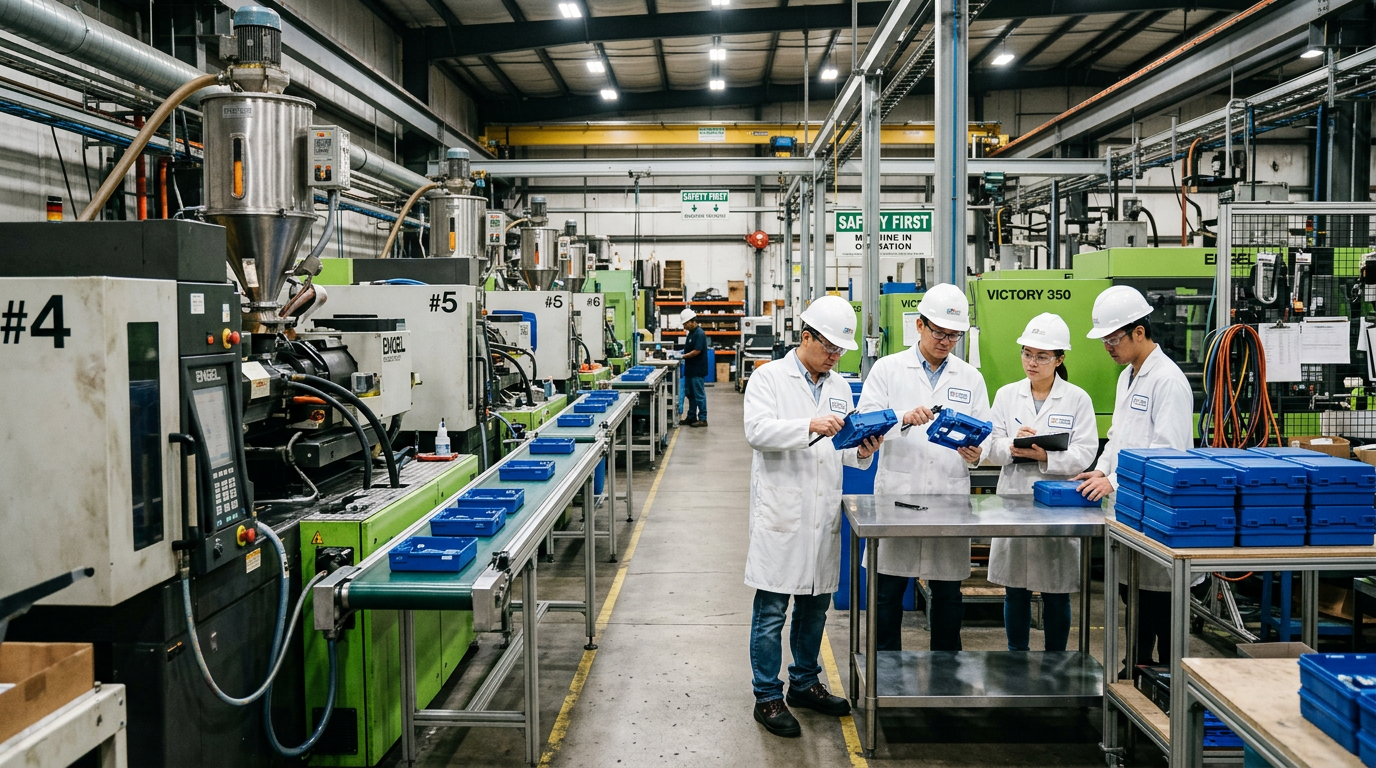
The OEM process for protective cases has 5 steps: (1) Specification 1-3 days, (2) Quotation and 3D design 3-5 days, (3) Sample production 7-10 days, (4) Mass production 15-30 days, (5) QC and delivery 5-10 days. Total 30-55 days. MOQ 300 pcs, tooling $3,000-$8,000. IP protection included. 87% of KeXinMaterials OEM orders are repeat business.
Complete OEM/ODM case customization guide: 5-step process, MOQ tiers, tooling costs, material options, lead times, IP protection, factory selection. From a 12-year source factory.
OEM/ODM customization is the most common way B2B buyers source protective cases. Done well, it gives you a product tailored to your application with exclusive branding, optimized foam, and factory-direct pricing. Done poorly, it wastes 6-12 months and $50,000+ on tooling that doesn't meet your needs.
This guide is based on KeXinMaterials' 12 years of OEM/ODM experience, with 3,000+ custom tooling projects and 150+ active OEM clients. We walk you through the 5-step process, the 4 MOQ tiers, real cost breakdowns, lead time expectations, common pitfalls, and IP protection strategies.
Key fact: At KeXinMaterials, 87% of OEM orders are repeat business. The most common reason customers return: we deliver on the promised specs and timeline, with full material traceability and SGS test reports included.
OEM and ODM are often confused, but they describe fundamentally different relationships.
You provide the complete design — drawings, 3D model, specifications, materials. The factory manufactures to your spec. Your tooling, your IP, your brand. Typical use case: a brand that has its own product design but needs a factory to manufacture it. The factory is interchangeable as long as they meet the spec.
The factory provides the design (often based on an existing platform with modifications). You bring the brand and the marketing. The factory retains the underlying design IP, but you typically get exclusive rights for your market. Typical use case: a startup or distributor who wants a branded product without investing in R&D. Faster to market (no design phase).
The most common arrangement for protective cases. You start with the factory's standard platform (saves 3-6 months of R&D), then customize: dimensions, foam cutouts, color, logo, accessories. You own the customization IP; the factory owns the base design IP. This is what KeXinMaterials offers for 80%+ of clients.
If you have an in-house engineering team and 6+ months runway: OEM is right. If you need to launch in 3 months or have no engineering team: ODM or hybrid is faster and cheaper. The cost difference is typically 20-30% (OEM higher due to design amortization).
Every reputable OEM case manufacturer follows a 5-step process. Here is what each step looks like at KeXinMaterials.
You submit your requirements via our 5-step inquiry form, email, or WhatsApp. Required information: dimensions, material, IP rating, color (RAL/Pantone code), foam type, logo artwork, quantity, target price, and any special certifications. Our engineering team responds within 12 hours with feasibility review and questions.
We issue a formal quotation (PI) with itemized cost: unit price, tooling cost, foam cost, customization fees, payment terms. For orders ≥500 pcs, 3D design and engineering are free. You receive a 3D rendering of the case + foam for visual approval.
Upon PI confirmation and 50% tooling deposit, we produce a pre-production sample (PPS) in the actual mold. Sample cost: $50-$300 per unit, fully refundable against order. Sample shipping: 3-5 days by DHL/FedEx. You approve or request modifications (up to 3 rounds included).
After sample approval and 30% T/T production deposit, mass production begins. Lead time depends on quantity: 15 days for ≤1,000 pcs, 20 days for ≤5,000 pcs, 30 days for ≤10,000 pcs, 45 days for ≥10,000 pcs. Progress reports with photos sent every 5 days.
100% inspection on critical dimensions, IP test on 5% of batch, drop test on 1%, color match verification, foam precision check. Final inspection report with photos and videos sent for approval. Balance 70% T/T before shipment. Sea (25-40 days DDP), air (5-7 days), or express (3-5 days).
Total timeline: 30-55 days for typical orders, 60-90 days for large custom tooling. Start your OEM inquiry →
OEM pricing has three components: unit price, tooling (one-time), and customization fees. Here is how they break down for a typical mid-size IP67 case (35×25×15cm, PP, with foam insert).
| Tier | Quantity | Unit price (FOB) | Tooling cost | Customization |
|---|---|---|---|---|
| Tier 1 (Sample) | 50-100 pcs | $35-$55 | $3,000-$5,000 (shared) | Color/logo only |
| Tier 2 (Small) | 300-1,000 pcs | $20-$35 | $3,000-$5,000 (exclusive) | Color/logo/custom foam |
| Tier 3 (Medium) | 1,000-5,000 pcs | $15-$25 | $3,000-$5,000 (exclusive) | Full custom |
| Tier 4 (Large) | 5,000+ pcs | $10-$18 | Free (≥10,000 pcs) | Full custom + exclusive tooling |
Standard: 30% T/T deposit + 70% balance before shipment. For new customers, 50% deposit may be required. L/C at sight accepted for orders ≥$50,000. Open account terms (Net 30/60) available for established customers with credit approval.
Two concerns every OEM buyer should address upfront: IP protection and quality assurance.
There are three levels of IP protection for OEM cases:
KeXinMaterials has never had an IP dispute in 12 years. Our standard PI includes: tooling ownership, NDA, and exclusivity clause (if applicable).
A reliable OEM partner provides:
IP67 is a rating from the IEC 60529 international standard. 'IP' = Ingress Protection. The '6' means completely dustproof. The '7' means resistant to temporary water immersion (1m depth for up to 30 minutes).
IP67 can withstand temporary water immersion. IP65 can only withstand low-pressure water jets. IP67 is suitable for outdoor and marine environments; IP65 is sufficient for rain exposure.
PP is lightest, most chemical-resistant, and food-safe. ABS is harder, glossier, and easier to color-match. PC is strongest and most premium but costliest. For most applications, ABS offers the best balance.
At KeXinMaterials, standard SKUs are available from 50-100 pcs. Custom OEM/ODM orders start at 300 pcs.
Sampling: 7-10 days. Mass production: 15-25 days. Sea freight: 25-40 days. Total: 30-45 days from deposit to your warehouse.
Third-party labs like SGS, TÜV, BV, and CTI perform IP testing. Typical cost is $500-$2,000 per test. Turnaround is 7-15 days.
Standard IP67 cases do not float. If you need flotation, ask for closed-cell foam inserts or external flotation collars.
1-year warranty against manufacturing defects. Lifetime technical support. Free replacement for any case that fails the IP test within 30 days of receipt.
KeXinMaterials source factory, 12 years of IP67 case manufacturing, 150+ SKUs across 9 product lines, exported to 50+ countries. OEM/ODM custom, 30-day delivery.