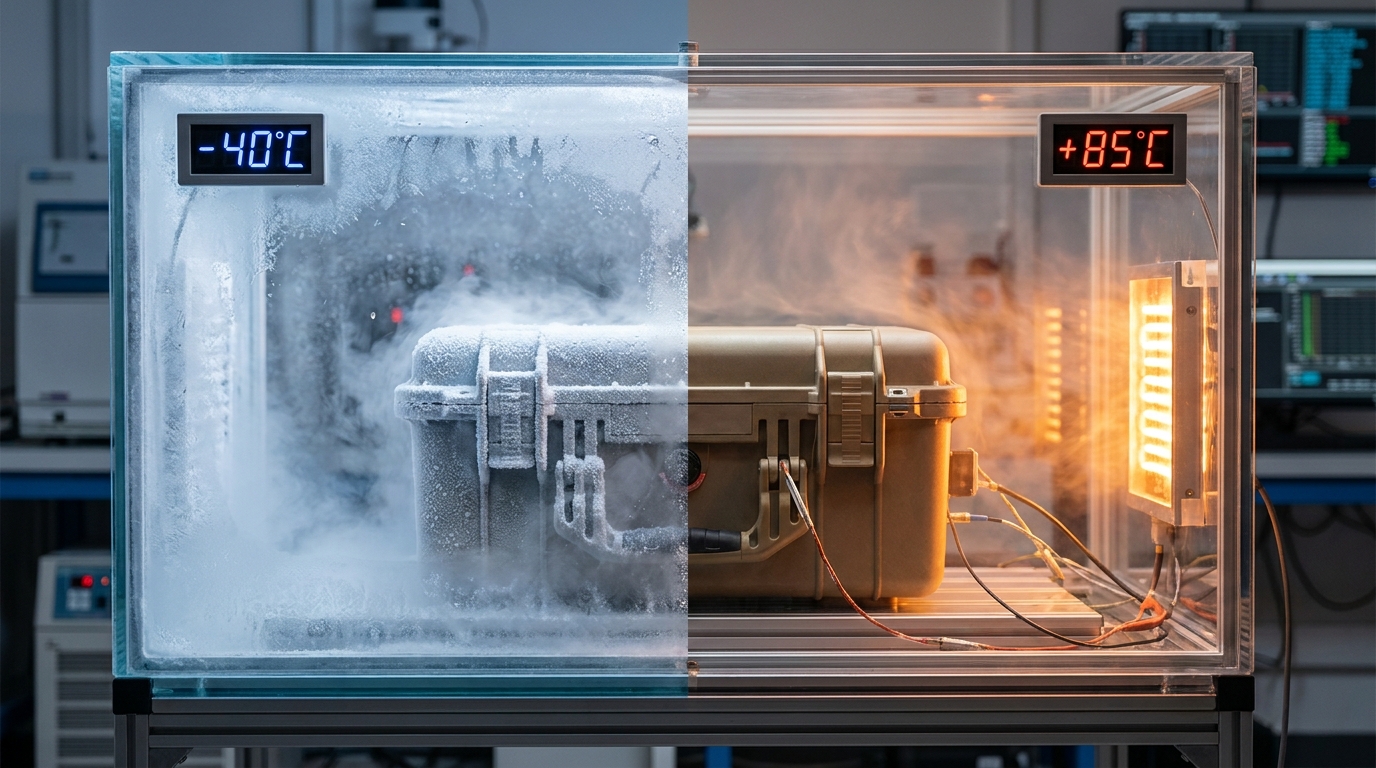
MIL-STD-810H 方法 501.7(高温)和 502.7(低温)测试设备在极端热环境中的运行能力。对于用于北极、沙漠和航空航天应用的防护箱,此测试至关重要。我们的 8 系列防护箱在 -40°C 至 +70°C 的完整运行范围进行了测试。
| 测试阶段 | 温度 | 时长 | 锁扣功能 | 密封圈功能 | 通过 |
|---|---|---|---|---|---|
| 运行高温 | +49°C / +71°C | 8 小时 | 正常 | 密封 | ✓ |
| 存储高温 | +71°C | 48 小时 | 正常 | 密封 | ✓ |
| 运行低温 | -40°C / -51°C | 8 小时 | 正常(轻微硬化) | 密封 | ✓ |
| 存储低温 | -51°C | 48 小时 | 正常(轻微硬化) | 密封 | ✓ |
-40°C 至 +70°C 运行范围支持以下场景:
-40°C 至 +70°C 运行,-51°C 至 +71°C 存储。完整 MIL-STD-810H 方法 501.7/502.7 范围。
能 —— TPU 密封圈额定 -51°C 不丧失弹性。
-51°C 至 +71°C,适合全球运输和仓储。
Standard cases: -20°C to +80°C. Cold-rated (Arctic): -40°C to +80°C. Cold-rated extreme: -55°C to +80°C. Hot-rated: -40°C to +95°C. Hot-rated extreme: -40°C to +120°C. Custom formulations available for specific temperature ranges.
Test per Mil-Std-810 Methods 501/502 (high/low temperature) and IEC 60068-2-1/2. Cases are placed in environmental chambers and exposed to temperature extremes for 24-72 hours. After each cycle, cases are inspected for cracking, warping, and gasket integrity.
Cold-rated: PP or HDPE with low-temperature additives (cold-flex agents), EPDM gaskets. Hot-rated: glass-filled nylon (up to +150°C), silicone gaskets. For extreme cold (-55°C), we use specialized elastomers and impact-modified PP.
No. Standard cases are not rated for cryogenic temperatures (below -55°C). For cryogenic applications (liquid nitrogen, dry ice), we use specialized cases with metal (aluminum) construction and thermal isolation. These are custom-engineered per application.
Standard PP and ABS have moderate UV resistance. For outdoor applications, we add UV stabilizers (carbon black, HALS) rated for 2000+ hours of QUV exposure. For tropical deployments, we recommend PC (polycarbonate) which has the best UV resistance.
Closed-cell PE foam maintains properties from -40°C to +80°C. For extreme cold (-55°C), we use special cold-rated foam with low-temperature plasticizers. For extreme heat (+95°C), we use high-temperature foam (silicone-based or cross-linked PE).
Standard: EPDM (-40°C to +120°C). Cold: silicone rubber (-60°C to +200°C). Hot: fluoroelastomer (FKM, -20°C to +230°C). We select gasketing based on the operating temperature range and chemical exposure.
Standard thermal cycling: 24-72 hours (3-5 cycles). Extreme temperature qualification: 7-14 days including rapid thermal cycling, thermal shock, and extended dwell at temperature extremes. We provide detailed test reports with thermal cycling curves.
Yes. We test per Mil-Std-810 Method 501.7 (high temperature, +30°C to +71°C operational, +85°C storage) and Method 502.7 (low temperature, -20°C to -51°C operational, -57°C storage). Our Arctic-grade cases meet the -51°C operational requirement.
Yes. We provide temperature test reports on request with NDA. Reports include: temperature profile, exposure duration, post-test inspection photos, and certification signature. Available in PDF and CSV formats for OEM clients.