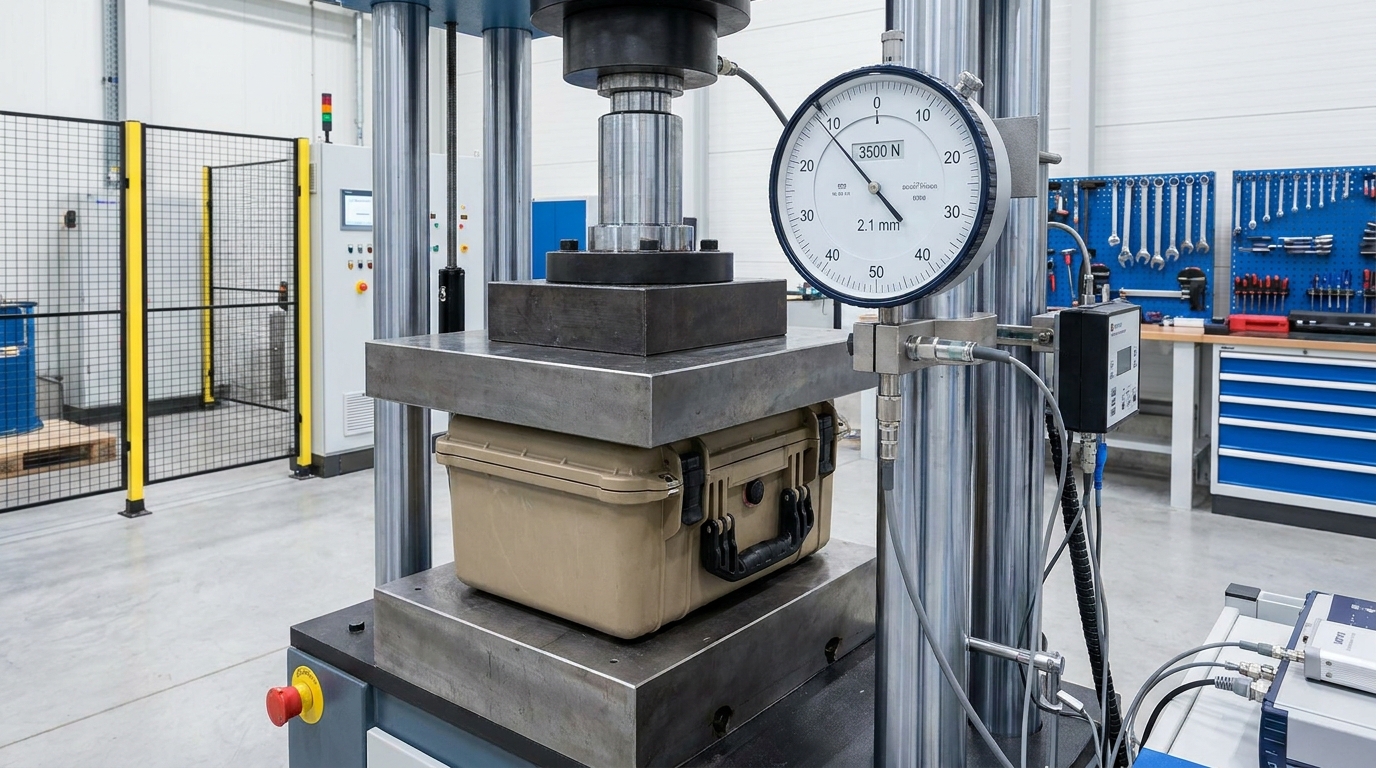
防护箱必须承受堆叠运输的压缩载荷 —— 仓库中堆叠 3-5 层高的托盘、集装箱船和货舱。我们的 8 系列防护箱按 ASTM D642(确定运输容器压缩阻力的标准测试方法)和 ISTA 3A(包裹递送系统包装产品)测试了压缩载荷。
| 样品 | 变形前最大载荷 | 100kg 时永久变形 | 150kg 时永久变形 | 通过 |
|---|---|---|---|---|
| 单元 1 | 185 kg | <1% | <2% | ✓ |
| 单元 2 | 192 kg | <1% | <2% | ✓ |
| 单元 3 | 178 kg | <1% | <3% | ✓ |
100kg+ 承重能力使仓库和集装箱运输中安全堆叠 4-5 个箱体高。100kg 时 <2% 变形确保 IP67 密封在实际堆叠存储下保持。对于重载应用(采矿、石油天然气),我们提供加固型(KX-8-HD)额定 250 kg。
8 系列防护箱承受 100kg+ 载荷,变形 <2%。加固 KX-8-HD 额定 250 kg。
ASTM D642(压缩)和 ISTA 3A(包裹递送系统)。
是的,仓库或集装箱运输中可堆叠 4-5 层高。
A compression load test measures a case's ability to withstand stacking or crushing forces without deformation or damage. The case is placed between two flat platens and loaded to a specified force (typically 50-500kg) for a defined time.
Cases often need to support stacking during shipping and storage. Compression testing ensures the case won't collapse under typical warehouse or transport loads, protecting the contents from crushing damage.
Common standards: ASTM D4169 (Transport), ISTA 2A/3A/3E (transport simulation), ISO 2234 (Packaging - Stacking), TAPPI T 804 (compression), and Mil-Std-810 Method 514.8 (vibration under load). We test to customer-specified standards.
Our plastic cases withstand 200-500kg static load (depending on size and material). For heavy-duty cases (steel-frame), compression strength exceeds 1000kg. Test results are reported in the case specification sheet.
Standard compression test: 1-2 hours per sample. Full qualification (5 samples, multiple loads): 2-3 days. We provide a detailed test report with load-deflection curves, deformation measurements, and pass/fail criteria.
Yes, in most cases. Plastic cases are designed to deform elastically under load and return to shape. For cases showing permanent deformation >2%, we recommend not using them for critical applications.
Static compression: constant load over time (typical 24-72h). Dynamic compression: cyclic load (vibration, impact). Both are important for transport. We perform both types based on customer requirements.
Common failure modes: shell buckling (top/bottom), wall cracking, latch failure, hinge deformation, handle fracture. We design cases to avoid these modes through FEA simulation and prototype validation.
Compression testing is required for cases used in stackable warehouse operations, sea freight (where heavy containers may be stacked), and Mil-Spec applications. For consumer cases, compression testing is optional but recommended.
Yes. We provide test certificates for all production batches upon request. Certificates include compression test results, batch number, manufacturing date, and inspector signature. Available in PDF, CSV, and JSON formats.