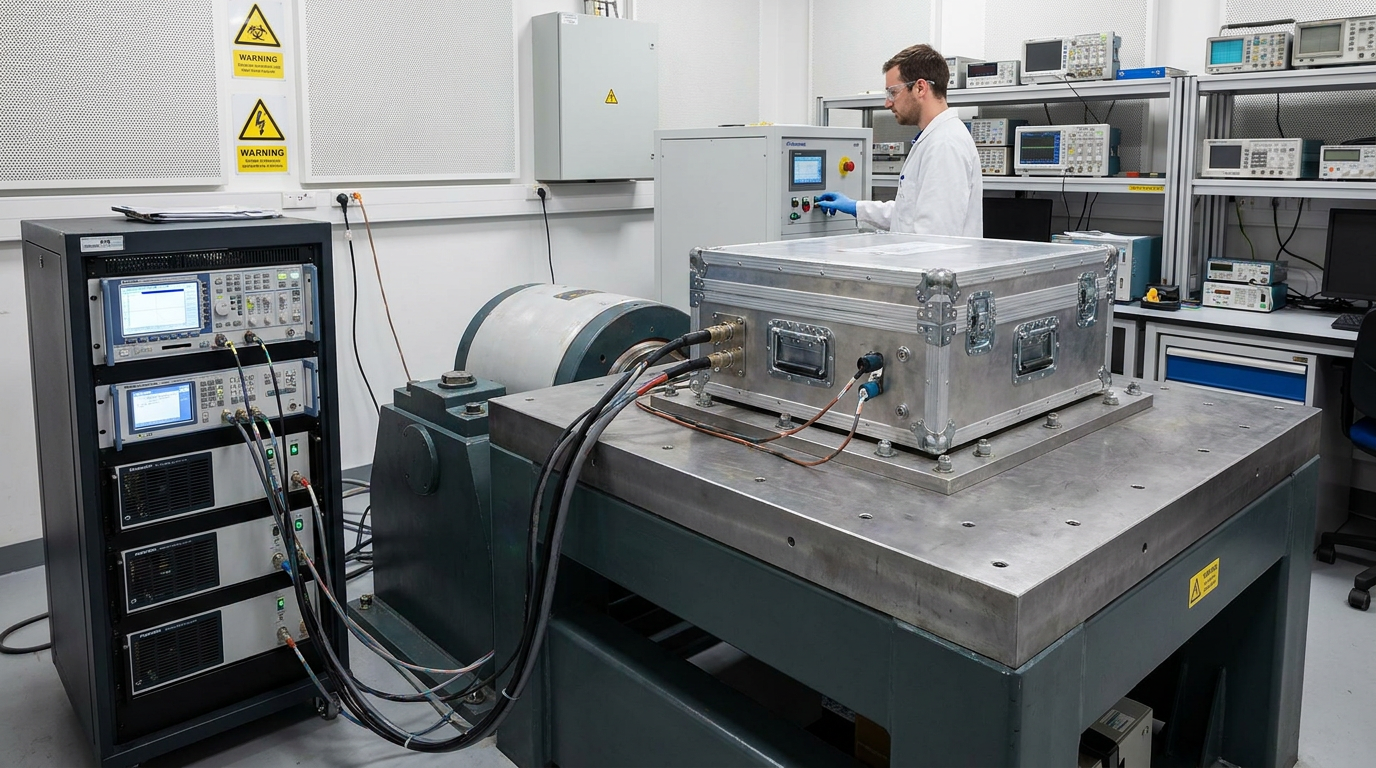
MIL-STD-810H Method 514.8 (Vibration) tests the ability of equipment to survive the vibration environment of various transport modes — truck, rail, ship, aircraft. For protective cases used in helicopter, ship, and rough-road applications, this test is critical. Our Series 8 cases were tested for both random and sinusoidal vibration on all 3 axes.
| Sample | Random vibration | Sinusoidal vibration | Functional check (post) | Pass |
|---|---|---|---|---|
| Unit 1 | No damage | No damage | Pass | ✓ |
| Unit 2 | No damage | No damage | Pass | ✓ |
| Unit 3 | No damage | No damage | Pass | ✓ |
This test satisfies vibration requirements for:
Method 514.8 (Vibration) tests the ability of equipment to survive the vibration environment of various transport modes.
Random vibration 5-500 Hz, sinusoidal 5-200 Hz.
3 axes (X, Y, Z), per the standard procedure.
Vibration testing simulates the random and sinusoidal vibrations cases experience during transport, particularly air freight, sea freight, and vehicle-mounted applications. It ensures cases can protect contents under realistic vibration conditions.
Sinusoidal vibration: single-frequency, swept (e.g., 5-500 Hz). Common in legacy military and aerospace testing. Random vibration: simultaneous multi-frequency, statistically defined power spectral density. Common in modern transport testing (ASTM D4169, ISTA 3A).
Common standards: Mil-Std-810 Method 514 (vibration), ASTM D4169 (Transport), ISTA 2A/3A/3E (transport simulation), RTCA DO-160 (aircraft), IEC 60068-2-6 (vibration), and Mil-Std-167 (shipboard). We test to customer-specified standards.
Cases are mounted on a vibration table (electro-dynamic or hydraulic shaker) and exposed to defined vibration profiles for 1-3 hours per axis (X, Y, Z). Acceleration levels: 1-5 Grms random, 2-10g sinusoidal. Cases are inspected for damage and contents are checked for displacement.
Cases for: air freight (helicopter, fixed-wing), vehicle-mounted applications, shipboard equipment, rail transport, off-road vehicles, and any application with rotating machinery. We recommend vibration testing for all cases used in transport.
Common failure modes: latch loosening, hinge failure, foam compression set, hardware loosening, weld cracking, paint chipping. We design cases to avoid these modes through FEA simulation, prototype validation, and field testing.
Standard vibration test: 1-2 hours per axis (3-6 hours total). Full qualification: 2-3 days including pre-conditioning, random + sinusoidal profiles, post-test inspection. Detailed test reports provided with vibration response curves.
Yes. Our military and aerospace-grade cases are tested per Mil-Std-810 Method 514.8 (vibration) for helicopter (Category 14), fixed-wing jet (Category 14), and tracked vehicle (Category 20) profiles. We test in our in-house lab and verify with third-party labs annually.
Yes. Cases are designed to withstand vibration without damage. Foam may show minor compression set (5-10%) but recovers. Hardware should be re-torqued after initial vibration exposure. We provide a 'post-vibration inspection checklist' for field use.
Yes. We provide vibration test reports on request with NDA. Reports include: vibration profile, exposure time, post-test inspection photos, foam compression measurements, and certification signature. Available in PDF, CSV, and JSON formats.