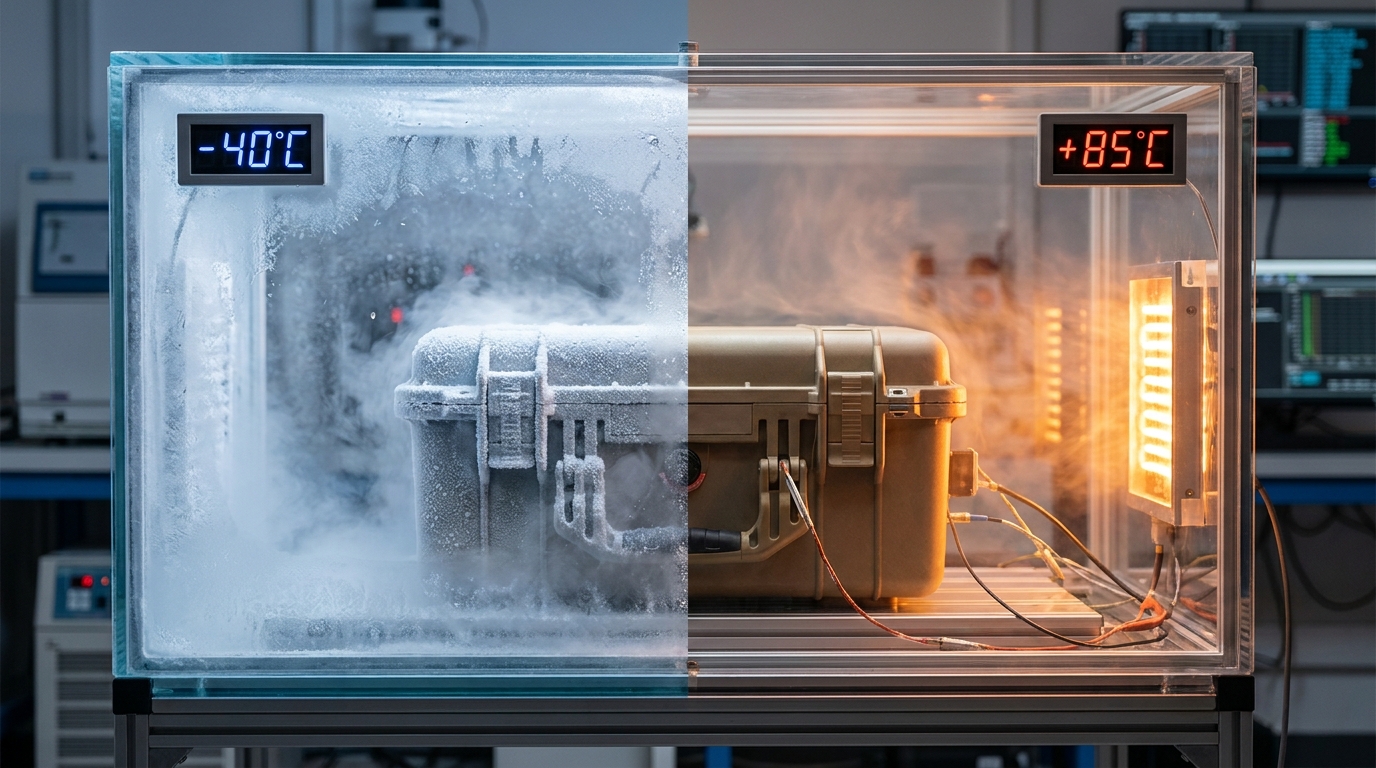
MIL-STD-810H Method 501.7 (High Temperature) and 502.7 (Low Temperature) test the ability of equipment to operate in extreme thermal environments. For protective cases used in arctic, desert, and aerospace applications, this test is critical. Our Series 8 cases were tested across the full operational range of -40°C to +70°C.
| Test phase | Temperature | Duration | Latch function | Gasket function | Pass |
|---|---|---|---|---|---|
| Operational high | +49°C / +71°C | 8 hours | Normal | Sealed | ✓ |
| Storage high | +71°C | 48 hours | Normal | Sealed | ✓ |
| Operational low | -40°C / -51°C | 8 hours | Normal (slight stiffening) | Sealed | ✓ |
| Storage low | -51°C | 48 hours | Normal (slight stiffening) | Sealed | ✓ |
The -40°C to +70°C operational range enables use in:
-40°C to +70°C operational, -51°C to +71°C storage. The full MIL-STD-810H Methods 501.7/502.7 range.
Yes — the TPU gasket is rated to -51°C without loss of elasticity.
-51°C to +71°C, suitable for global transport and warehousing.
Standard cases: -20°C to +80°C. Cold-rated (Arctic): -40°C to +80°C. Cold-rated extreme: -55°C to +80°C. Hot-rated: -40°C to +95°C. Hot-rated extreme: -40°C to +120°C. Custom formulations available for specific temperature ranges.
Test per Mil-Std-810 Methods 501/502 (high/low temperature) and IEC 60068-2-1/2. Cases are placed in environmental chambers and exposed to temperature extremes for 24-72 hours. After each cycle, cases are inspected for cracking, warping, and gasket integrity.
Cold-rated: PP or HDPE with low-temperature additives (cold-flex agents), EPDM gaskets. Hot-rated: glass-filled nylon (up to +150°C), silicone gaskets. For extreme cold (-55°C), we use specialized elastomers and impact-modified PP.
No. Standard cases are not rated for cryogenic temperatures (below -55°C). For cryogenic applications (liquid nitrogen, dry ice), we use specialized cases with metal (aluminum) construction and thermal isolation. These are custom-engineered per application.
Standard PP and ABS have moderate UV resistance. For outdoor applications, we add UV stabilizers (carbon black, HALS) rated for 2000+ hours of QUV exposure. For tropical deployments, we recommend PC (polycarbonate) which has the best UV resistance.
Closed-cell PE foam maintains properties from -40°C to +80°C. For extreme cold (-55°C), we use special cold-rated foam with low-temperature plasticizers. For extreme heat (+95°C), we use high-temperature foam (silicone-based or cross-linked PE).
Standard: EPDM (-40°C to +120°C). Cold: silicone rubber (-60°C to +200°C). Hot: fluoroelastomer (FKM, -20°C to +230°C). We select gasketing based on the operating temperature range and chemical exposure.
Standard thermal cycling: 24-72 hours (3-5 cycles). Extreme temperature qualification: 7-14 days including rapid thermal cycling, thermal shock, and extended dwell at temperature extremes. We provide detailed test reports with thermal cycling curves.
Yes. We test per Mil-Std-810 Method 501.7 (high temperature, +30°C to +71°C operational, +85°C storage) and Method 502.7 (low temperature, -20°C to -51°C operational, -57°C storage). Our Arctic-grade cases meet the -51°C operational requirement.
Yes. We provide temperature test reports on request with NDA. Reports include: temperature profile, exposure duration, post-test inspection photos, and certification signature. Available in PDF and CSV formats for OEM clients.