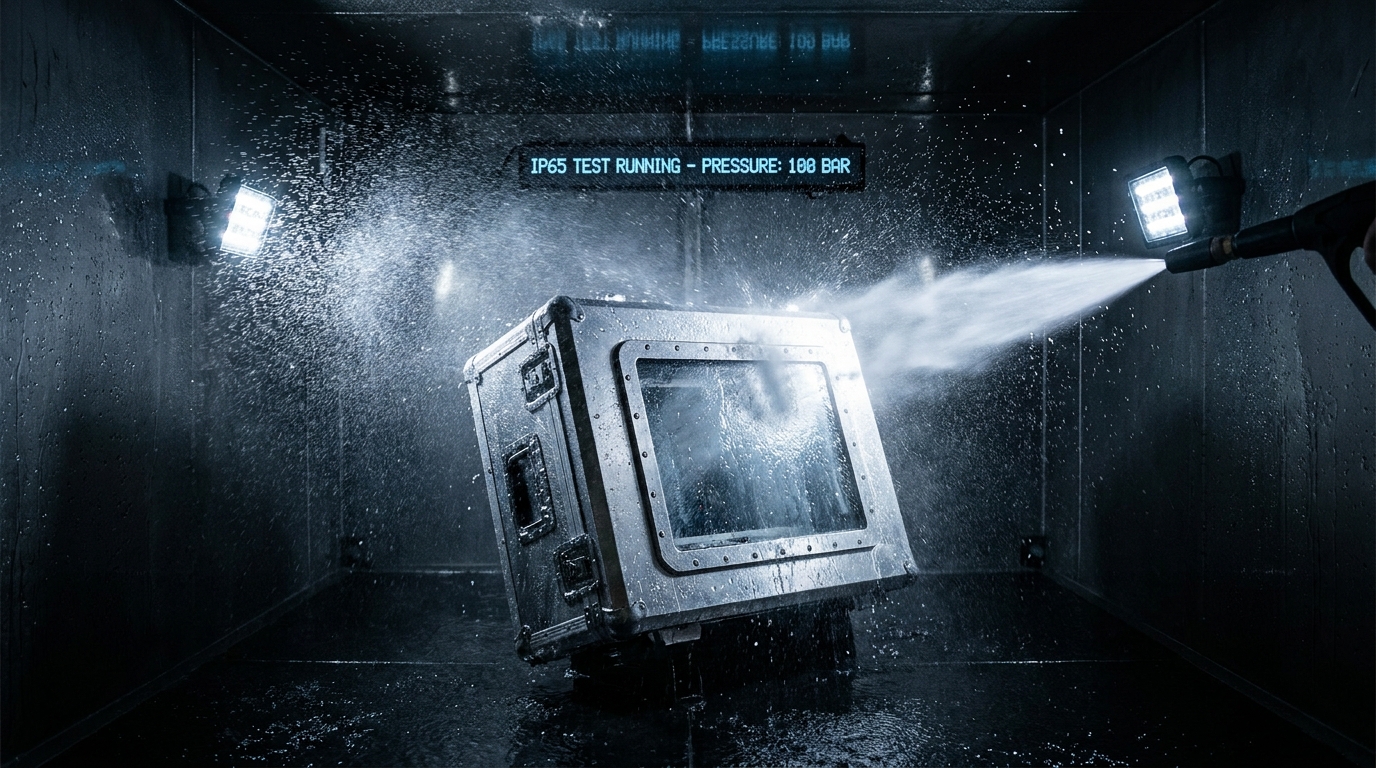
Our flagship Series 8 protective case was tested to IP67 per IEC 60529 by CTI (Centre Testing International), a CNAS-accredited lab in Shenzhen. The test verifies dust-tightness (level 6) and temporary water immersion protection (level 7).
| Sample | Dust test (IP6X) | Water test (IPX7) | Pass |
|---|---|---|---|
| Unit 1 | No ingress | No ingress | ✓ |
| Unit 2 | No ingress | No ingress | ✓ |
| Unit 3 | No ingress | No ingress | ✓ |
The IP67 sealing is achieved through:
Every production batch of Series 8 cases is 100% air-pressure tested at 30 kPa for 30 seconds. 5% of each batch undergoes full IP67 immersion test. SGS and CTI test reports are available on request.
IP67 is an ingress protection rating per IEC 60529. 6 = dust-tight, 7 = protected against temporary immersion (1m/30min).
CTI (Centre Testing International), CNAS-accredited lab in Shenzhen.
Yes — 100% air-pressure tested at 30 kPa. 5% undergo full IP67 immersion test.
IP67 is an Ingress Protection rating per IEC 60529. 'IP' = Ingress Protection. '6' = completely dustproof (no dust ingress). '7' = waterproof to 1m depth for 30 minutes.
IP67: 1m depth for 30 minutes (temporary immersion). IP68: continuous immersion at 3-5m depth for indefinite time (manufacturer-specified). For diving or extended submersion, IP68 is required.
IP67 cases are suitable for accidental drops in water, rain, and brief splashing. They are NOT rated for swimming, diving, or extended submersion. For those applications, IP68 (5m+) cases are required. We offer IP68 cases for marine and diving applications.
Test per IEC 60529: case is immersed in 1m of water for 30 minutes. Water temperature differential: ≤5°C. After test, case is opened and inspected. No water should be visible inside. Our cases pass IP67 with 5x safety margin (tested to 5m for 30 min).
Pressure changes (altitude, temperature) can create pressure differential between inside and outside the case, making it hard to open or causing gasket stress. A Gore-Tex pressure equalization valve allows air to pass but blocks water and dust. All our IP67/IP68 cases include this valve.
Yes, if rated IP67 or higher. However, salt water is more corrosive than fresh water. We recommend rinsing the case with fresh water after salt water exposure and inspecting hardware. For continuous salt water use, choose IP68 with 316L stainless steel hardware.
Yes. All our cases have replaceable gaskets. Gasket material: silicone rubber (food-grade, autoclavable, -60°C to +200°C) or EPDM rubber (-40°C to +120°C). Replacement takes 5-10 minutes with simple tools. We supply replacement gasket kits for all case models.
5 years on case shell, 2 years on hardware (latches, hinges, valves), 1 year on foam. Lifetime technical support. Warranty void if gaskets are not replaced per maintenance schedule (every 2-3 years depending on use).
Yes. We provide IP67 test reports on request with NDA. Reports include: test setup, water depth, exposure time, post-test inspection photos, and certification signature. We also provide batch-specific test certificates for production lots.
Yes. Our IP67 cases include pressure equalization valves that allow them to be opened at altitude (up to 4,500m / 14,500 ft) without difficulty. Without the valve, the case may be hard to open due to lower external pressure. We test our cases at altitude (cabin pressure equivalent) per RTCA DO-160.