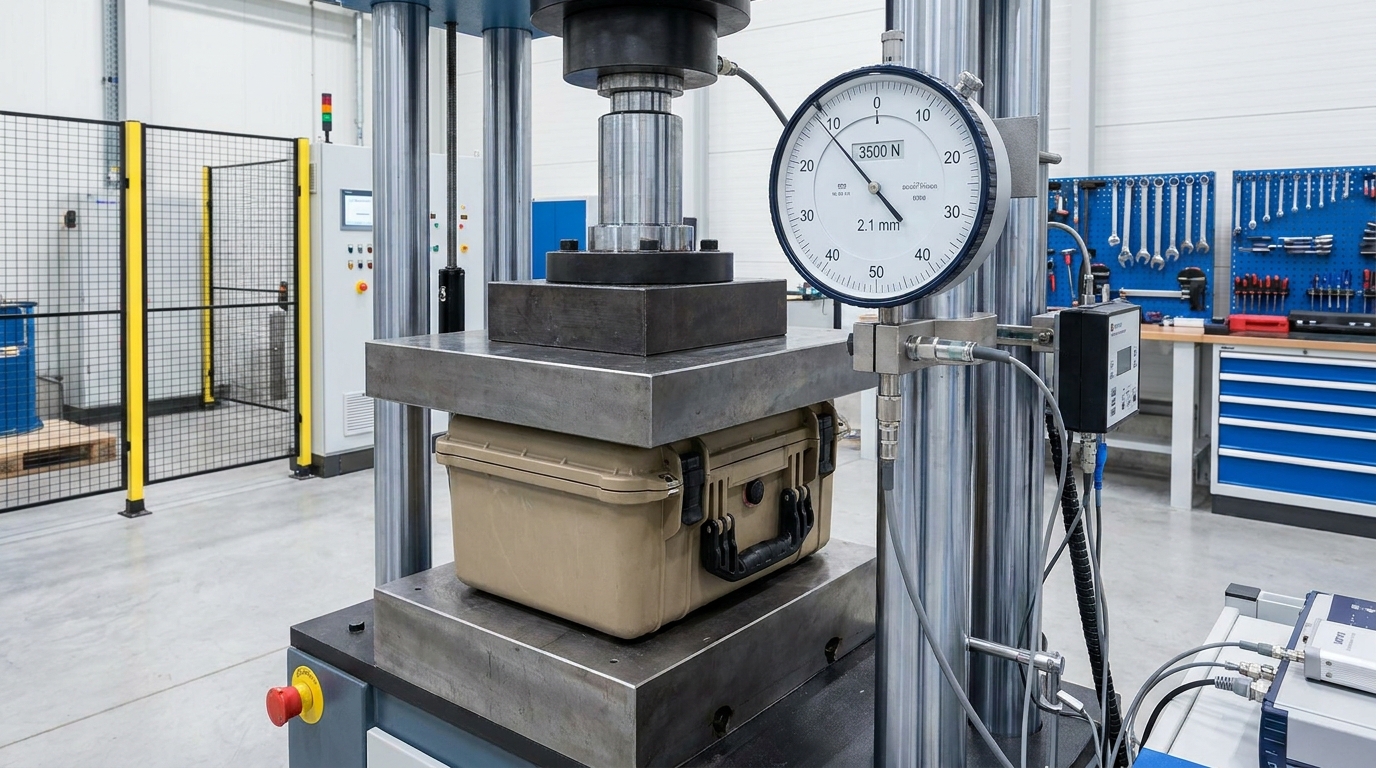
Protective cases must withstand the compressive loads of stacked transport — pallets stacked 3-5 high in warehouses, container ships, and cargo holds. Our Series 8 cases were tested for compression load per ASTM D642 (Standard Test Method for Determining Compressive Resistance of Shipping Containers) and ISTA 3A (Packaged Products for Parcel Delivery System).
| Sample | Max load before deformation | Permanent deformation at 100 kg | Permanent deformation at 150 kg | Pass |
|---|---|---|---|---|
| Unit 1 | 185 kg | <1% | <2% | ✓ |
| Unit 2 | 192 kg | <1% | <2% | ✓ |
| Unit 3 | 178 kg | <1% | <3% | ✓ |
100 kg+ load capacity enables safe stacking of 4-5 cases high in warehouses and during containerized shipping. The <2% deformation at 100 kg ensures that the IP67 seal is maintained even under realistic stacked storage. For heavy-duty applications (mining, oil & gas), we offer a reinforced variant (KX-8-HD) rated to 250 kg.
Series 8 cases sustain 100 kg+ load with <2% deformation. Reinforced KX-8-HD rated to 250 kg.
ASTM D642 (compression) and ISTA 3A (parcel delivery system).
Yes, up to 4-5 cases high in warehouse or containerized shipping.
A compression load test measures a case's ability to withstand stacking or crushing forces without deformation or damage. The case is placed between two flat platens and loaded to a specified force (typically 50-500kg) for a defined time.
Cases often need to support stacking during shipping and storage. Compression testing ensures the case won't collapse under typical warehouse or transport loads, protecting the contents from crushing damage.
Common standards: ASTM D4169 (Transport), ISTA 2A/3A/3E (transport simulation), ISO 2234 (Packaging - Stacking), TAPPI T 804 (compression), and Mil-Std-810 Method 514.8 (vibration under load). We test to customer-specified standards.
Our plastic cases withstand 200-500kg static load (depending on size and material). For heavy-duty cases (steel-frame), compression strength exceeds 1000kg. Test results are reported in the case specification sheet.
Standard compression test: 1-2 hours per sample. Full qualification (5 samples, multiple loads): 2-3 days. We provide a detailed test report with load-deflection curves, deformation measurements, and pass/fail criteria.
Yes, in most cases. Plastic cases are designed to deform elastically under load and return to shape. For cases showing permanent deformation >2%, we recommend not using them for critical applications.
Static compression: constant load over time (typical 24-72h). Dynamic compression: cyclic load (vibration, impact). Both are important for transport. We perform both types based on customer requirements.
Common failure modes: shell buckling (top/bottom), wall cracking, latch failure, hinge deformation, handle fracture. We design cases to avoid these modes through FEA simulation and prototype validation.
Compression testing is required for cases used in stackable warehouse operations, sea freight (where heavy containers may be stacked), and Mil-Spec applications. For consumer cases, compression testing is optional but recommended.
Yes. We provide test certificates for all production batches upon request. Certificates include compression test results, batch number, manufacturing date, and inspector signature. Available in PDF, CSV, and JSON formats.